Closeboard fencing
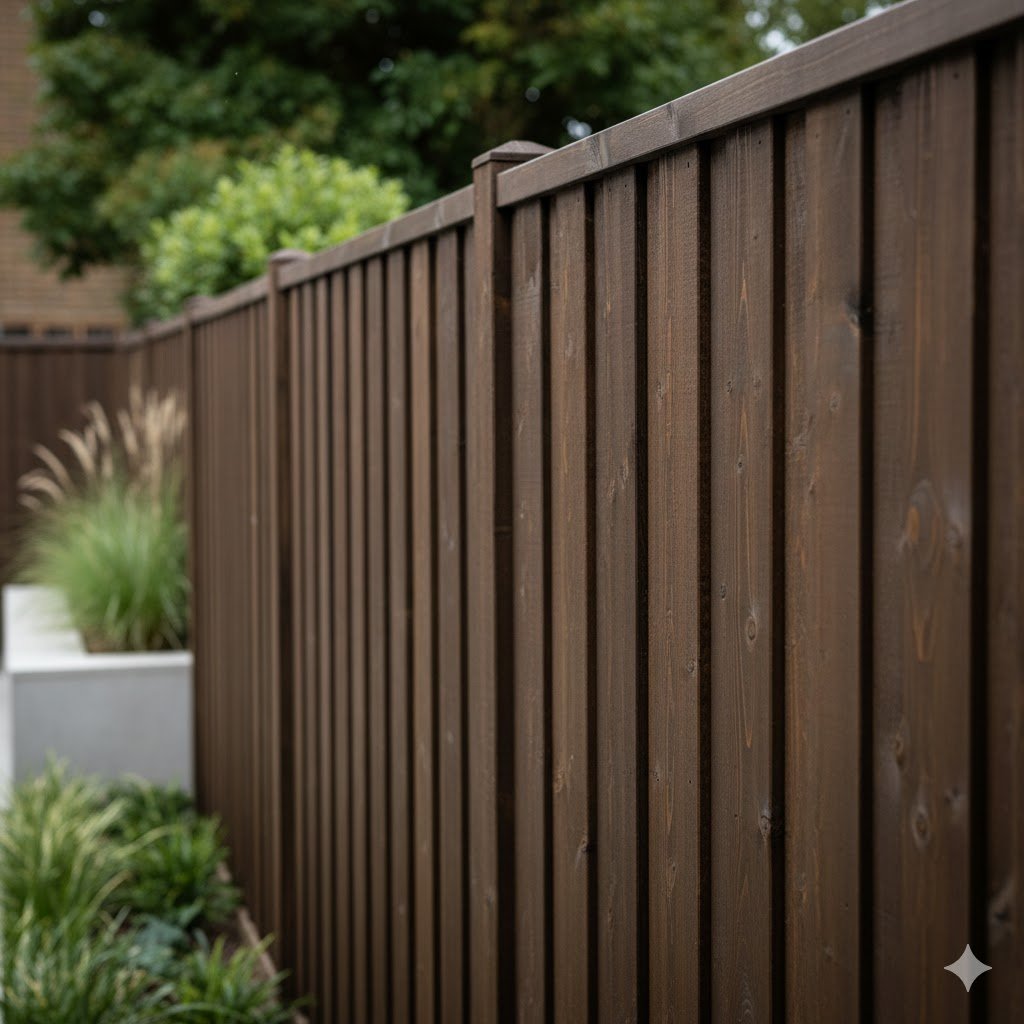
Also called featherboard or feather-edge fencing. Vertical boards are nailed one at a time to rails between the posts, so the fence is built to your boundary rather than dropped into it in panels. It is the fence we are asked for most across London.
About closeboard fencing
A closeboard fence has four parts: posts, triangular arris rails running between them, tapered feather-edge boards nailed upright to the rails with each one overlapping the last, and a gravel board along the bottom. Because every board is fixed on its own, the fence follows your boundary exactly, can be raked to follow a slope, and a damaged board can be replaced without touching the rest.
That construction is also why it stands up to wind better than a panel fence. The boards flex slightly and share the load along the rails, where a prefabricated panel catches the wind as one sheet and levers on its two posts.
- Usual height1.8m at the back
- PostsConcrete or timber
- On a slopeCan be raked
- PrivacyFull, no gaps
How a closeboard fence is built
Spacing set by the rails
Arris rails come in lengths of about three metres, which sets the widest gap between posts. Roughly a quarter to a third of each post goes into the ground: around 600mm for a 1.8m fence. Concrete posts are morticed to take the rails; timber posts are notched.
Three rails at full height
A 1.8m fence normally takes three arris rails; lower fences take two. The triangular section sheds rain, and the rails carry every board, so each end is fixed firmly into its post.
Overlapped, nailed once per rail
The thick edge of each board covers the thin edge of the next, typically by about 25mm, so the fence stays closed as the timber shrinks in a dry summer. Each board is nailed once per rail, which lets it move with the weather without splitting.
Gravel board and capping
A gravel board keeps the boards off the soil. A capping rail along the top keeps rain off the end grain. Both are small parts that add years at the two ends of the fence where timber gives out first.
Is it the right choice?
We would rather point you to the right job than the bigger one. This is how we would advise on site.
Choose it for
- Rear and side boundaries where you want full privacy
- Exposed or windy gardens
- Sloping ground, where the fence can follow the slope
- Long runs and boundaries that are not quite straight
Think twice if
- A short, sheltered boundary where budget decides: overlap panels cost less
- A front boundary next to a road, where the height limit is usually 1 metre and picket suits better
Closeboard fencing, answered
Yes. Closeboard, featherboard and feather-edge fencing are names for the same fence: tapered vertical boards overlapped on horizontal arris rails. Feather-edge describes the board; closeboard describes the finished fence.
In most back gardens in England, up to 2 metres without planning permission, which is why 1.8m is the usual height: it leaves room for a gravel board within the limit. Next to a road used by vehicles, or a footpath alongside one, the limit is usually 1 metre. Listed buildings, conservation areas and Article 4 directions can be stricter, so check with your council.
Yes, and that is one of its main advantages over panels. A split or rotten board is prised off and a new one nailed in its place. The new board will look paler than its weathered neighbours for a season or two; staining the run evens it out.
Related work
We work across London, with local pages for Barnet, Enfield, Finchley, Muswell Hill, Wood Green, Haringey, Camden, Hackney, Clapham, Wimbledon. See all areas we cover.
Get a written estimate
We measure the run, check the posts, the ground and the access, then put an itemised figure in writing. The visit and the estimate are free, and we reply within 24 hours.