Overlap fence panels
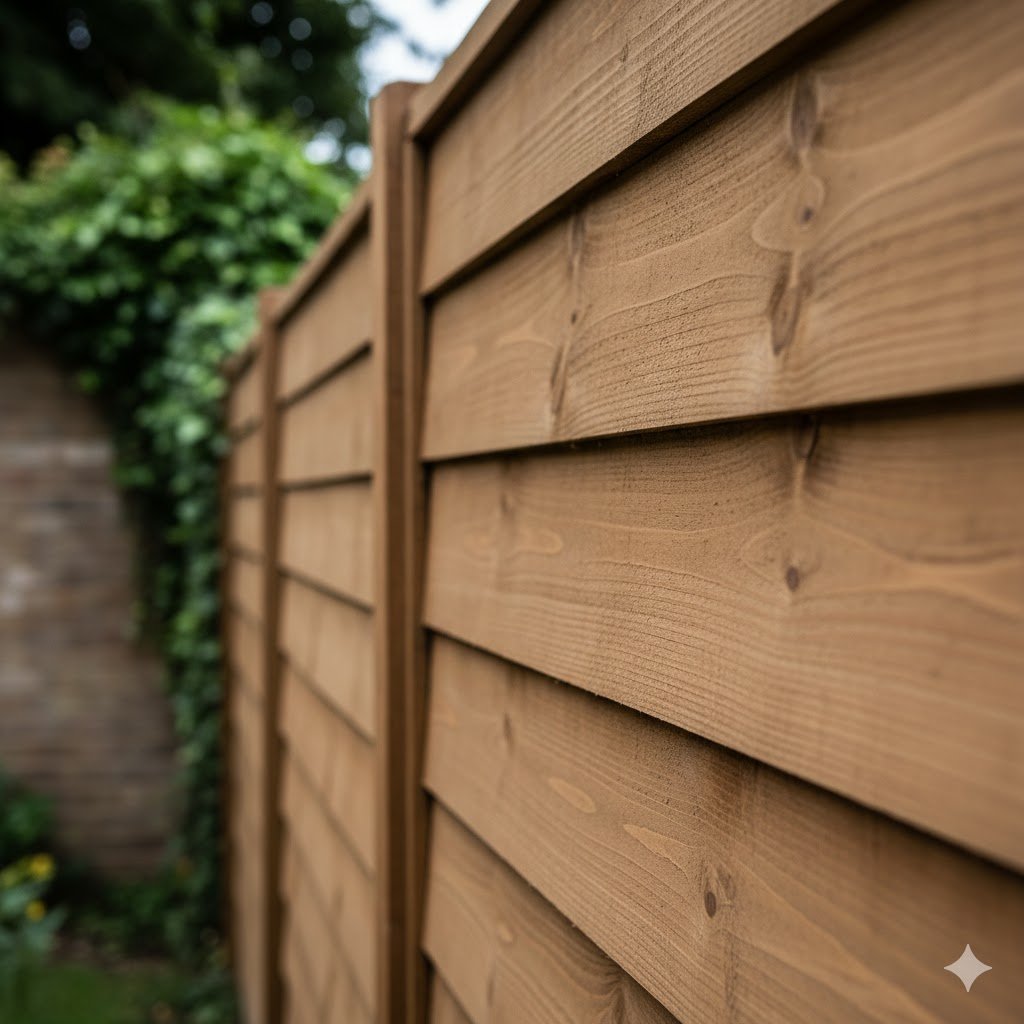
Ready-made panels of thin horizontal slats in a timber frame, fitted between posts. They are the most economical way to put up a solid garden fence, and they last well when the posts and gravel boards under them are done properly.
About overlap fence panels
An overlap panel is made in a factory: slats overlapping horizontally, held in a light frame. On site the panels drop into slotted concrete posts or are fixed between timber posts with brackets, so a run goes up quickly.
The trade-off is strength. A panel catches the wind as one sheet and passes the whole load to its posts, and the slats are thin. On a sheltered boundary between two gardens that is rarely a problem. On an exposed run, closeboard is the better choice, and we will say so at the survey.
- Panel width1.83m standard
- Heights0.9m to 1.83m
- PostsConcrete or timber
- Best onSheltered boundaries
What makes a panel fence last
The part that decides its life
Most panel fences fail at the posts, not the panels. Posts go in to the right depth and are set in concrete. With slotted concrete posts, a broken panel can later be lifted out and replaced without touching the posts.
Panels kept off the soil
A gravel board under every panel means the bottom slats never sit in wet ground, which is where cheap panel fences rot first. Concrete gravel boards in concrete posts remove the problem.
Pressure-treated, not just dipped
Panels are sold either dip-treated, which colours the surface, or pressure-treated, where preservative is forced into the timber. Pressure-treated panels cost more and last considerably longer.
Stepped, never raked
A panel cannot follow a slope. Each bay stays level and steps down at the posts, with the gravel boards closing the triangle underneath.
Is it the right choice?
We would rather point you to the right job than the bigger one. This is how we would advise on site.
Choose it for
- Sheltered rear and side boundaries
- A solid fence on a tighter budget
- Replacing an existing panel fence like for like
Think twice if
- Exposed, windy runs: closeboard copes far better
- Slopes where you want one continuous line
- Front boundaries, which usually call for a lower, open fence
Overlap fence panels, answered
Because each panel acts as a sail. The wind load on a 1.83m panel goes into two posts, and if either is rotten at ground level or set too shallow it snaps or pulls out. Well-set concrete posts, pressure-treated panels and a gravel board underneath are the main defence.
Usually, yes. In slotted concrete posts a panel slides out and a new one slides in; with timber posts the brackets are unscrewed. A new panel looks brighter than its weathered neighbours until it tones down or is stained.
Panels come in steps from 0.9m to 1.83m. For privacy on a rear boundary, 1.83m panels on a gravel board are usual, which keeps the total under the 2 metre height that normally applies without planning permission.
Related work
We work across London, with local pages for Barnet, Enfield, Finchley, Muswell Hill, Wood Green, Haringey, Camden, Hackney, Clapham, Wimbledon. See all areas we cover.
Get a written estimate
We measure the run, check the posts, the ground and the access, then put an itemised figure in writing. The visit and the estimate are free, and we reply within 24 hours.